About the Matisse exhibition


The birth of a chromatic symphony
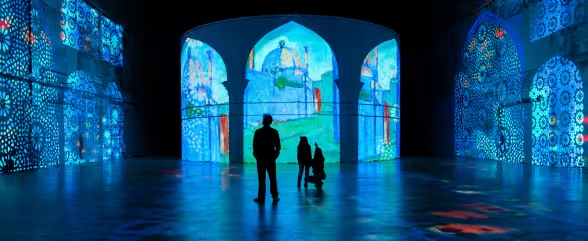
Matisse invites you to explore the power of colour through a chromatic journey. Blue, red, yellow and other pure colours shape the experience, accompanied by the artist’s reflections on their importance. Blue, his colour of choice, comes to the fore in the famous Blue Nudes of 1952, created from cut-out painted paper. Colour then becomes a constellation of shimmering touches in Luxe, Calme et Volupté (1904), inviting you into an idyllic seaside scene.
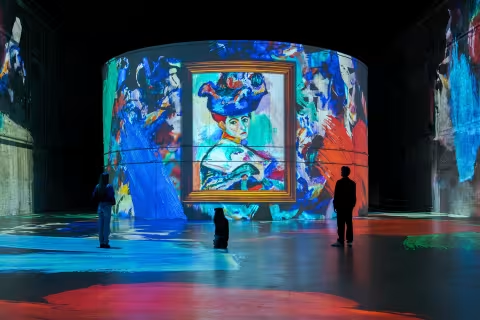
Green, The boldness of fauvism
Step into the explosion of colour that defined Matisse’s Fauvist period. A leading figure of the movement, he used pure colour to create vibrant, expressive compositions. In 1905, his Woman with a Hat caused a sensation at the Salon d’Automne and helped inspire the term “Fauves”. The journey continues through Matisse’s Mediterranean landscapes, flooded with intense colour and alive with energy, atmosphere and emotion.

Orange, The wonder of travel
An avid traveller, Matisse drew inspiration from the light, colours and patterns he encountered on his journeys. His stays in Algeria and Morocco marked a major turning point: intense light and geometric motifs inspired bold contrasts and freed his compositions from traditional perspective. Blue takes on a new prominence, deep and meditative, bathing the medinas and enveloping the female figures.

Blue, Freedom of movement
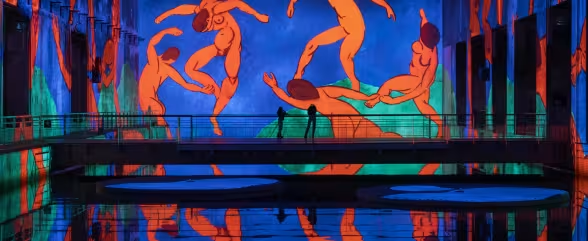
Dance fascinated Matisse and became one of the major themes of his work. In The Dance (1910), painted for Russian collector Sergei Shchukin and inspired by traditional circle dances, five nude figures form an open ring, symbolising joy and vitality. Against an azure-blue sky, Matisse reduces his palette to just a few colours and radically simplifies the figures, creating a pure, almost idyllic vision of dance.
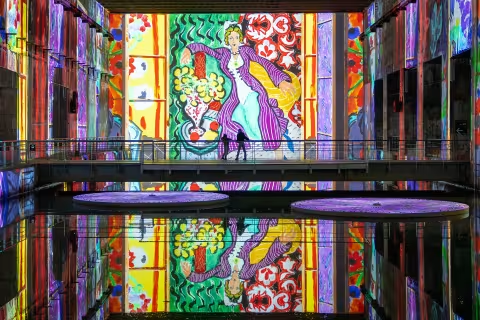
Purple, The intimate beauty of everyday life
Born in Le Cateau-Cambrésis, a region renowned for its textile craftsmanship, Matisse grew up surrounded by fabrics that would leave a lasting mark on his work. Textiles, patterns and flowers fill his colourful interiors, where warm and cool tones, indoors and outdoors, foreground and depth intertwine. Through these scenes of everyday life, Matisse transforms ordinary moments into scenes of grace, serenity and vitality.
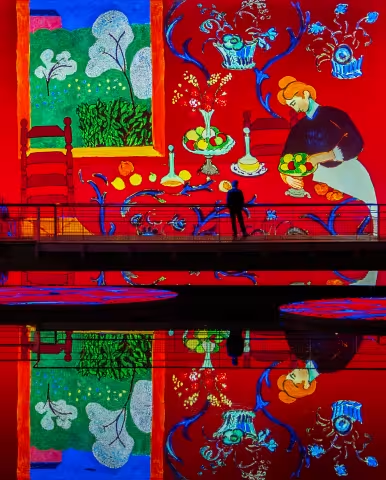
Culturespaces / Geoffroy Groult Red, Atmospheric harmony
This color allows Matisse to break free from the superflu and transforms his studio into a monochrome composition. Based on photographs recreating his various studios, Matisse invites us to be carried away by this saturated and bold Venetian red, which floods his creative universe and absorbs everything unnecessary along the way.
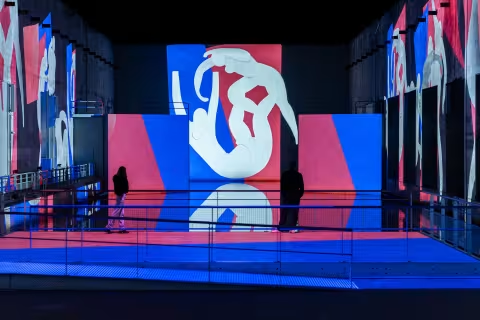
Pink, The optimism of seeing bigger
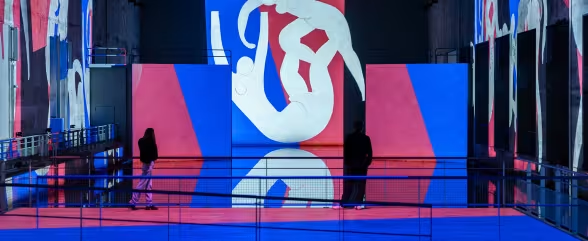
Matisse’s fascination with dance and movement takes on a new dimension through his exploration of monumental architecture. In 1929, while working on The Dance for the Barnes Foundation in the United States, he experimented with cut-out coloured paper to compose on a monumental scale. Pink and blue interact with the space, while the fragmented bodies of the dancers seem to extend their movement beyond the boundaries of the architecture.
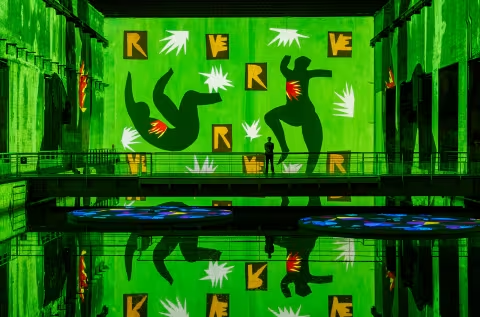
Light Green, Resilience as transcendence
Despite illness, Matisse continued his artistic exploration with renewed energy, turning painted paper cut-outs into a new means of expression. With Jazz, created at the initiative of his publisher Tériade, he explored colour through three worlds: the circus, travel and folk tales. Cutting directly into colour, Matisse created spontaneous, vibrant forms, much like a sculptor carving directly into material.
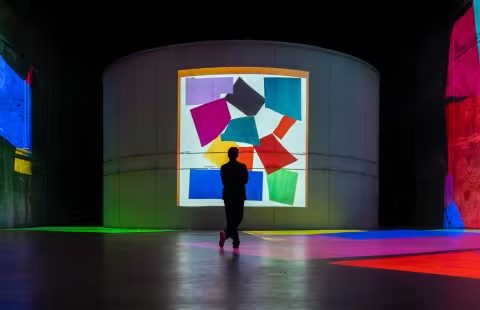
Yellow, Essential Joy
During the final decade of his life, Matisse made painted paper cut-outs the culmination of his exploration of colour, “drawing” directly with scissors. In The Sheaf, The Sorrow of the King and The Snail, organic forms, colours and spaces come together in dynamic compositions. Fascinated by Beethoven, Matisse approached his works like a symphony, with each shape and colour finding its place within a harmonious whole.

Black, The clarity of stained glass
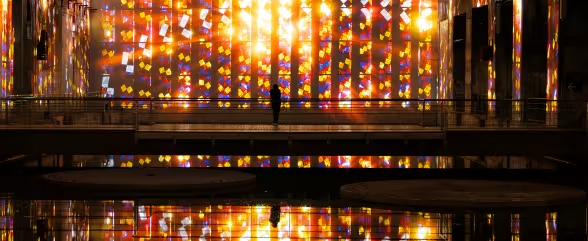
The journey concludes with the stained-glass work Fleuve de vie, originally designed for the chapel of Vence and realized by master glassmaker Paul Bony in a kindergarten in Le Cateau-Cambrésis. Inaugurated after the artist’s passing, the work was renamed Les Abeilles, a vibrant symbol of Matisse’s tireless pursuit. This finale completes a journey in which each work becomes a promise of freedom, serenity, and happiness, the artistic legacy Matisse sought to convey throughout his life.
Henri Matisse: 10 Key Dates
1869
Birth
Henri-Émile-Benoît Matisse was born in Le Cateau-Cambrésis, in northern France. He grew up surrounded by the rich fabrics and textiles produced in this region, famous for its textile craftsmanship, which would inspire some of his works.
1892-1897
Matisse in Paris
1905
Scandal
At the Salon d'Automne, his paintings, exhibited alongside those of Derain, Marquet, Vlaminck, and Van Dongen, caused a scandal. The bright colors, applied in broad strokes, challenged convention and astonished the public. Art critic Louis Vauxcelles dubbed them “fauves” (wild beasts), a term that was immediately adopted to describe this first major avant-garde movement of the 20th century.

1909
La danse
The great Russian collector Sergei Shchukin commissioned two monumental decorative panels for the grand staircase of his palace: La Danse et La Musique. Inspired by a small circle already present in La Joie de vivre, Matisse created two compositions designed as celebrations of energy, rhythm, and color.
1917
Mediterranean period
He settled permanently in Nice, beginning a long Mediterranean period marked by softer light, interiors, and odalisque figures. His studio became a vibrant creative space where he staged models with oriental fabrics and objects brought back from his travels.
1929
A Work for the Barnes Foundation
Matisse received a commission from Albert Barnes, founder of a large art collection near Philadelphia. Returning to the theme of dance, he devoted himself almost entirely to this monumental work. After producing an initial version that he deemed insufficiently decorative, he used his cut-paper technique. A third version, adapted to the exact dimensions of the room, was installed in 1933 at the Barnes Foundation.
1930
Trip to Tahiti
He made his first trip to Tahiti. During his journey through the Pacific Islands, Matisse gave up painting almost entirely for several months. He observed, photographed, filled sketchbooks, and immersed himself in a landscape reduced to its essentials: sea, sky, lagoons, light.

1947
Cut-paper technique
Despite his illness, Matisse focused on working in series and explored spontaneous compositions. During this period, he collaborated on the literary and artistic journal Verve, founded by the publisher Tériade, with whom he published the book Jazz in 1947. He used the technique of cut-out gouache papers and engraving to reproduce this work, which brings together colorful plates and pages of writing.

1948-1951
Last masterpiece
He designed every detail of the stained glass windows in the Chapel of the Rosary in Vence, considered his masterpiece. The organic forms of the landscapes he traveled through, which influenced him throughout his life, can be seen throughout the work. He created not only all of the stained glass windows but also several liturgical accessories, ceramics, and chasubles for the parish.
1954
Death
Henri Matisse passed away in Nice at the age of 84.

Listen to the playlist of the exhibition
Extend the immersive experience with the exhibition's official Spotify playlist.
Les œuvres phares
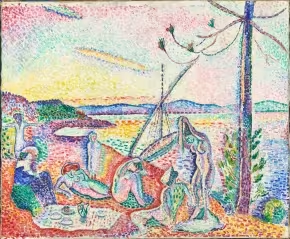
Luxe, calme et volupté
During his early stays in the Mediterranean basin, Matisse discovered a unique light that left a deep impression on him and encouraged him to break free from drawing in order to liberate color on the canvas. Initially attracted to divisionism, in 1904 in Saint-Tropez he explored a personal way of fragmenting the brushstroke in Luxe, calme et volupté. But the following year, in Collioure, the light acted as a revelation: alongside André Derain, he abandoned pointillism in favor of flat areas of pure color and intense contrasts. The work marked a major turning point and paved the way for Fauvism.
Henri Matisse, 1904, 98,5 x 118,5 cm, oil on canvas, Musée d’Orsay, Paris, © GrandPalaisRmn (musée d’Orsay) / Hervé Lewandowski

Dance (II)
At the turn of the 1910s, Henri Matisse went through a period of intense creativity. In 1909, Russian collector Sergei Shchukin commissioned him to create two monumental panels for his palace: La Danse and La Musique. In Dance (III), five nude figures form an open circle, symbolizing joy and vitality. Against an azure blue sky, Matisse radically simplified the forms and limited his palette to a few pure colors, creating an almost archaic and universal vision. Presented at the Salon d'Automne in 1910, the work caused a scandal before being defended by its patron.
Henri Matisse, 1909-1910, 260 x 391 cm, Oil on canvas, State Hermitage Museum, Saint Petersburg, akg-images / Album / Prisma

La gerbe
During the last decade of his life, Henri Matisse created monumental cutouts in gouache-painted wallpaper. In La Gerbe, the material becomes pure, vibrant color. Using scissors to “draw” directly in the color, he cut out organic, fluid shapes that he assembled into a dynamic composition. The space surrounding the shapes is as important as the shapes themselves: the solids and voids interact in a chromatic exaltation that synthesizes all his years of exploration.
Henri Matisse, 1953, 303,2 x 361 cm, Carreaux de céramique montés sur plâtre, Los Angeles County Museum, © 2025 Museum Associates / LACMA. Licenciée par Dist. GrandPalaisRmn / image LACMA

The Snail
He explains his creation of The Snail, a chromatic composition, in these terms: "First, I drew the snail from nature, holding it in my hand. I became aware of a process unfolding, I found an image in my mind purified of the shell, then I took up the scissors." He combines complementary colors (red and green, orange and blue, yellow and purple) to give the spiral a sense of dynamism.
Henri Matisse, 1953, 286,4 x 287 cm, Gouache on paper, cut and pasted on paper mounted on canvas, Tate Modern, Londres, © Tate, Londres, Dist. GrandPalaisRmn / Tate Photography
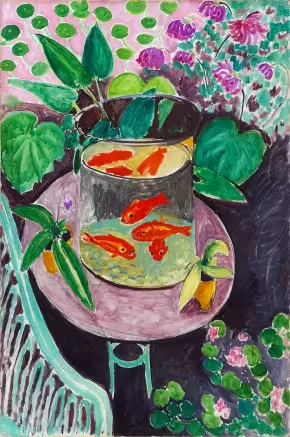
Gold fish
Flowers symbolize vitality for him. They allowed him to play with intense, contrasting colors and dynamic compositions.
Henri Matisse, 1912, 140 x 98 cm, oil on canvas, The Pushkin State Museum of Fine Arts, Moscou, akg-images
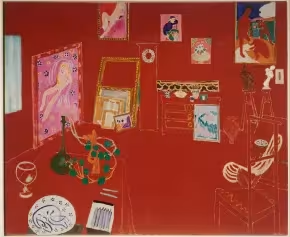
The Red Studio
For Matisse, the studio was a veritable inner world. He decorated it with plants, fabrics, objects brought back from his travels, and his own works, which he moved from one place to another. This space thus became a familiar setting and a constant source of inspiration. By painting his studio, Matisse created a form of self-portrait, revealing his intimate relationship with color and composition. The Red Studio, painted in 1911 in Issy-les-Moulineaux, brings together several works painted between 1898 and 1911, integrated into a vast red field that transforms the space into a unified vision. For example, we can recognize Les Baigneuses and Le Luxe (II), as well as a plate painted by the artist in 1907. Rejected by Shchukin, the painting then circulated in major international exhibitions before joining a private collection and being acquired in 1949 by the Museum of Modern Art (MoMA) in New York. From that date onwards, painters, critics, and visitors stopped in front of this work, whose chromatic audacity and simplification of space suddenly seemed visionary. For many, L’Atelier rouge heralded a new direction that would soon take the American art scene by storm: colorful abstraction.
Henri Matisse, 1911, 181 x 219,1 cm, huile sur toile, Museum of Modern Art, New York, akg-images

La danse
In 1930, Henri Matisse received a commission from Albert Barnes to create a mural for the Barnes Foundation. Taking up the theme of dance and movement, he designed a monumental work measuring 52 m². After an initial version was deemed insufficiently decorative, he used cut-out colored paper, which he placed and rearranged on the surface before painting the final composition. In La Danse, color transforms the architecture into an immersive space: pink harmonizes with blue, and fragments of bodies extend the movement beyond the frame.
Henri Matisse, 1932-1933, 340 x 441 cm (panneaux latéraux), 356 x 503 cm (panneau central), huile sur toile en trois panneaux, The Barnes Foundation, Philadelphia, © Barnes Foundation / Bridgeman Images

Icare, planche VIII du livre d'art JAZZ
During this period, Matisse collaborated with the literary and artistic journal Verve, founded in 1937 by the publisher Tériade, with whom he published the book Jazz in 1947. He used the technique of cut-out gouache papers, then engraving to reproduce this work, which brings together colorful plates and pages of writing. He began to imagine a universe of curves that cut through the black, creating a striking contrast and highlighting the subtle movements of the artist's hand. Matisse wrote about Jazz: “Cutting sharply into color reminds me of the direct carving of sculptors. This book was conceived in that spirit.”
Henri Matisse, 1947, Hauteur folio : 42 cm, Gravure d'après papiers collés, Tériade, 1947, musée Matisse, © akg-images